
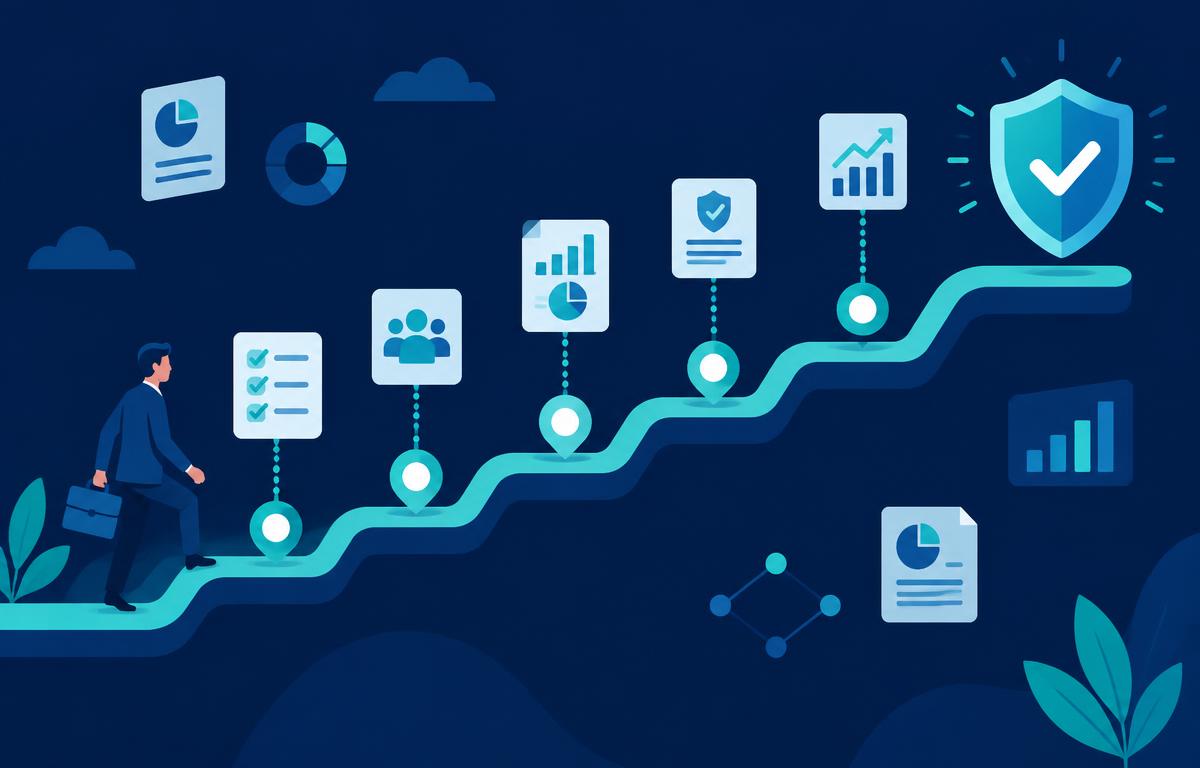
Building a governance, risk and compliance (GRC) program can feel overwhelming: frameworks, regulations, audits and tools all demand attention at once. The organisations that succeed do not try to do everything in month one. They follow a sequence — scope first, then risk, then controls, then evidence, then automation.
This guide walks through that sequence step by step.
Step 1: Define scope and objectives
Before choosing frameworks, answer three questions:
- What is in scope? Which business units, systems, cloud environments and locations does the program cover?
- What obligations apply? Which regulations and customer requirements actually bind you — not every framework you have heard of.
- What does success look like? A SOC 2 report within nine months is a different program from "improve security maturity over two years."
Write these answers down. A one-page charter with scope, objectives and an executive sponsor prevents most later confusion.
Step 2: Assess current state and risks
You cannot build controls for risks you have not identified. This step has two parts:
- Risk assessment. Identify threats and weaknesses across your systems, processes and vendors. Score each by likelihood and impact. Recognised approaches include ISO 31000 and the NIST risk management framework.
- Gap assessment. Compare your current controls against your target frameworks — for example ISO 27001 or SOC 2. This tells you how much work stands between you and your first audit.
Most organisations find that 60–70% of their gaps are documentation and process gaps, not missing technology. That is good news: those are faster and cheaper to close.
Step 3: Map controls to multiple frameworks
This is the step that separates an efficient GRC program from an expensive one. Instead of building a separate control set per framework, build one control library and map each control to every framework it satisfies.
For example, a single access-review control can satisfy:
- ISO 27001 Annex A access control requirements
- SOC 2 Security (Common Criteria) access requirements
- HIPAA access management safeguards
- Part of NIST CSF 2.0 in the Protect function
A simple spreadsheet works at first. What matters is that each control has: a description, an owner, the frameworks it covers, and where its evidence lives.
Step 4: Put governance in place
Controls without owners decay. Minimum viable governance:
- Named owners for each control or control domain
- A policy set that is approved, published and reviewed annually
- A risk committee or standing meeting that reviews the risk register and open issues
- Management reporting — a monthly or quarterly view of risk status, audit findings and remediation progress
If your organisation already has a security leader, this may be a light addition to their role. If not, options include a virtual CISO engagement or our GRC consulting service.
Step 5: Collect and organise evidence
Auditors and customers do not take your word for it — they look at evidence. Build evidence collection into the work itself rather than scrambling before an audit:
- Store evidence in one place, organised by control
- Record the date each piece of evidence was captured
- Automate collection where possible (cloud security tools can export many controls' evidence directly)
A SOC 2 readiness assessment or ISO 27001 internal audit is a good way to test whether your evidence would survive scrutiny.
Step 6: Choose tools — but not too early
GRC software (often called a GRC platform) can manage risk registers, control libraries, evidence and workflows in one place. Two cautions:
- Do not buy a platform before you have a program. A tool cannot compensate for undefined scope and unowned risks.
- Match the tool to your size. A 50-person company rarely needs an enterprise platform; a well-structured document set plus lightweight automation often suffices until you are managing several frameworks.
Step 7: Operate, measure and improve
A GRC program is a cycle, not a project. Keep it alive with:
- Regular risk reviews (at least quarterly)
- Control testing — check that controls operate, not just that they exist
- Internal audits before external ones
- Incident lessons fed back into the risk register
- Annual policy and scope review
Track a small set of measures: open high risks, overdue remediation, audit findings by severity, and time-to-close. These tell you whether the program is actually working.
Common mistakes to avoid
- Chasing certificates before risks. Certification is an output, not the goal.
- Building for the auditor, not for risk. Controls that exist only on paper fail on the second audit.
- No executive sponsor. Without one, priorities slip and owners are never held accountable.
- Duplicating work per framework. The whole point of GRC is reuse.
- Treating it as a one-time project. The program needs a heartbeat.
How CyberWave GRC helps
CyberWave GRC is a governance, risk and compliance consulting firm serving clients in India and the USA. We help organisations build GRC programs that hold up: GRC consulting, gap assessments, audit and certification support, security testing and team training. Our lead auditor has handled over 200 SOC 1 and SOC 2 audits, and we work on fixed fees.
Start with a conversation about where your program stands today — contact us.
Frequently asked questions
See the FAQ section below for common questions about building a GRC program.