
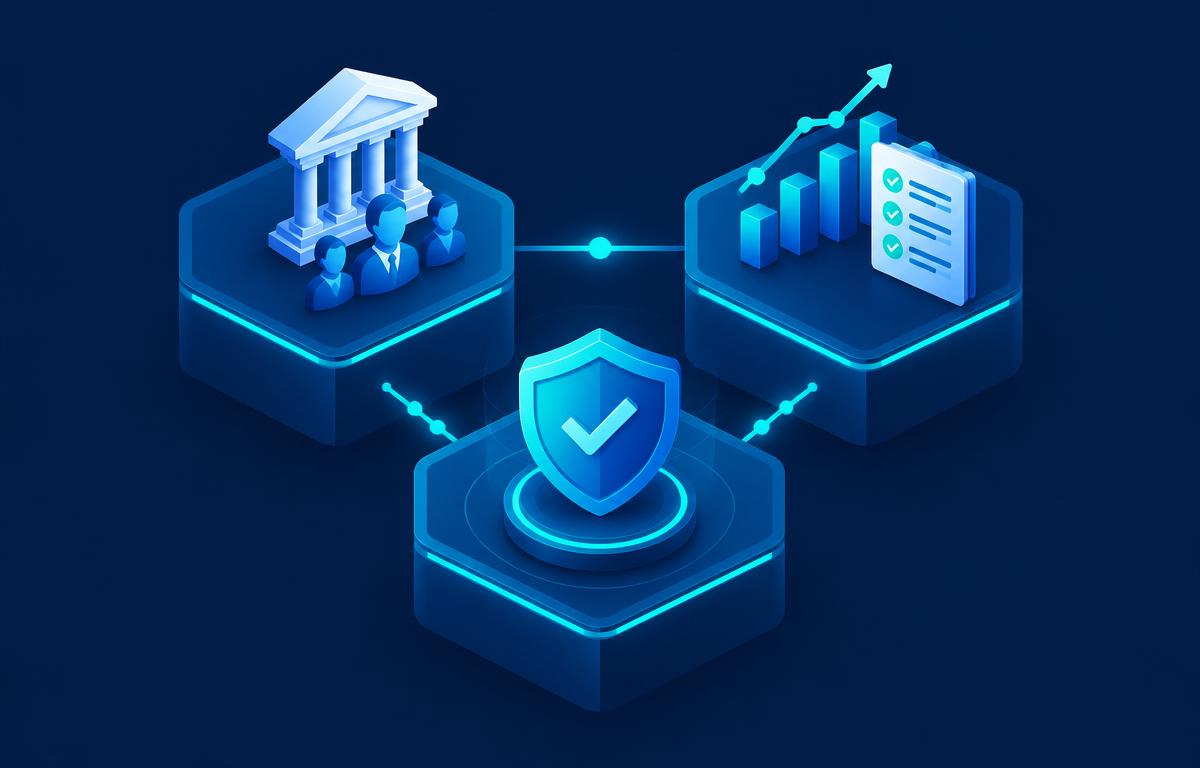
GRC stands for governance, risk and compliance — the three disciplines that keep an organisation's decisions, risks and obligations aligned with one another. In practice, GRC is less a single product or certificate and more the way a company runs these three things together instead of in separate silos.
This guide explains what each part means, how they fit together, how GRC differs from compliance alone, and how to tell whether your organisation needs a formal GRC program.
The three parts of GRC
Governance
Governance is how decisions get made and who is accountable for them. It covers things like:
- Board and executive oversight of security and compliance
- Clear roles and responsibilities (who owns risk, who approves policy)
- A documented policy framework that staff can actually follow
- Reporting lines so problems reach the right people quickly
Without governance, risk and compliance work becomes reactive: each audit or customer question is handled in isolation, and nobody owns the whole picture.
Risk
Risk is about finding out what could go wrong, how likely it is, and what it would cost — then deciding what to do about it. A working risk process includes:
- Identifying threats and weaknesses across systems, vendors and processes
- Scoring risks by likelihood and impact
- Choosing a response: treat, tolerate, transfer or terminate
- Reviewing risks on a schedule, not just once
Frameworks such as ISO 31000 and NIST's risk management resources give you recognised ways to structure this work.
Compliance
Compliance is meeting the rules that apply to you — laws, regulations and standards — and being able to prove it. For most organisations we work with, that means some combination of:
- ISO 27001 for information security management
- SOC 2 reports for customers who ask how you protect their data
- HIPAA or HITRUST for healthcare data
- GDPR or India's DPDP Act for privacy
- CMMC or NIST CSF 2.0 for US government and critical infrastructure work
How the three work together
The power of GRC is the connections between the three parts:
| If you only have... | What goes wrong |
|---|---|
| Compliance, no risk process | You chase certificates without knowing which risks actually matter |
| Risk, no governance | Risk registers are filled in but nobody acts on them |
| Governance, no compliance | Policies exist on paper but cannot survive a customer audit |
When the three run together, one piece of work serves several purposes. For example, a control you implement for ISO 27001 can also answer a SOC 2 question, satisfy part of a customer security questionnaire and feed your risk register. That reuse is where the time savings in a mature GRC program come from.
GRC vs compliance: what's the difference?
Compliance asks: *do we meet this rule, and can we show it?* GRC asks the broader question: *are we making good decisions, managing the risks that matter, and meeting our obligations in a way that holds together?*
A company can be certified to ISO 27001 and still have a serious unmanaged risk — because the certificate only says the management system conforms to the standard, not that every risk was identified. GRC closes that gap by tying compliance evidence back to real risks and real owners.
Do you need a GRC program?
A formal GRC program usually makes sense when:
- You are facing two or more frameworks (for example ISO 27001 plus SOC 2), and doing them separately is creating duplicate work
- Customers, investors or regulators are asking increasingly detailed questions about your controls
- Your company is growing, and security decisions are being made ad hoc by different teams
- An audit or incident exposed gaps that nobody clearly owned
Smaller organisations can start with a lightweight version: a simple risk register, one owner for compliance, and a single list of obligations mapped to controls.
How CyberWave GRC helps
CyberWave GRC is a governance, risk and compliance consulting firm serving clients in India and the USA. We help organisations:
- Run a gap assessment to see where they stand against their target frameworks, through GRC consulting
- Build or simplify their GRC program through GRC consulting
- Prepare for and pass audits with audit and certification support
- Strengthen controls with security testing and VAPT
- Train their teams through our training services
If you are not sure where to start, contact us and we will help you scope the first step.
Frequently asked questions
See the FAQ section below for common questions about GRC.